
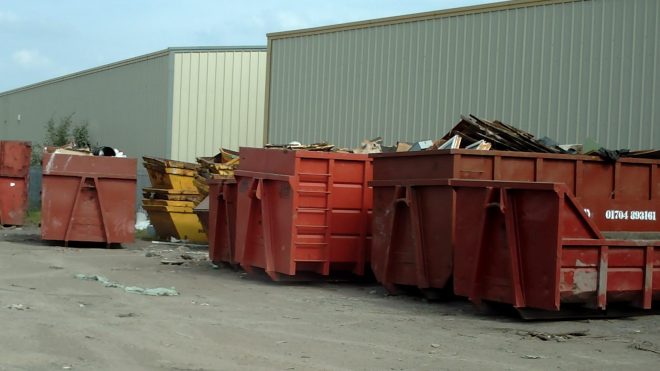
If you’re undertaking a big commercial or industrial project, you’ll quickly realise that not all skips are created equal. For jobs that generate massive amounts of waste and aren’t suitable for smaller skips, the 20 yard skip emerges as the best choice. As the smallest roll-on roll-off skip available, it balances capacity with practicality, making it ideal for heavy, bulky, or high-volume debris. In this post, we answer the common question: how big is a 20 yard skip? We’ll also cover what makes it a top pick for larger waste management tasks, what you can and cannot put in a skip, and how to secure the necessary permits.
Introduction to the 20 yard skip
When people ask, how big is a 20 yard skip, they’re usually picturing a sizeable container that can handle a substantial amount of waste without requiring a full-scale industrial skip. A typical 20-yard skip measures about 20 feet long, 8 feet wide and 4 feet high (6.10m x 2.44m x 1.07m). This dimension translates into a significant capacity: it can hold up to around 200 black bin bags full of waste, depending on the type and density of the material. This makes the 20 yard skip a popular choice for bigger commercial and industrial waste management tasks where space on site is available and where waste volumes exceed what smaller skips can manage efficiently.
The 20 yard skip sits on the boundary between standard domestic skips and larger roll-on roll-off (RORO) solutions, offering a practical balance of space and maneuverability. For construction sites, manufacturing cleanups, or large-scale office or shop fits, a 20 yard skip can streamline the waste removal process and reduce the number of trips needed.
Jobs suitable for a 20 yard skip
A 20-yard roll-on roll-off skip is the perfect choice for big industrial or commercial projects. Its size makes it especially effective in situations where waste is substantial and may include heavy or bulky items. Common scenarios include:
- Construction sites with substantial debris and packaging material
- Large renovation or demolition projects
- Warehousing or distribution centre cleanouts
- Manufacturing plants undergoing upgrades or extensions
- Bulk removal of non-hazardous commercial waste
Because of its capacity, the 20 yard skip can handle materials that would overwhelm smaller skips, such as concrete rubble, timber, metal scrap, and large quantities of mixed waste.
Prohibited items: what you cannot put in a skip
Skips are incredibly useful, but there are limits. Certain items should not be placed in a skip due to safety hazards, environmental concerns, or legal restrictions. Examples of items commonly prohibited include:
- Asbestos and asbestos-containing materials
- Chemicals and hazardous waste
- Electrical equipment containing hazardous components
- Fluorescent bulbs and lighting fixtures with mercury or other harmful substances
- Gas cylinders
- Batteries
- Fluids, solvents, paints (unless specifically permitted by the skip provider)
- Tyres
- Large quantities of waste that require special handling
Always check with your skip hire provider about their list of prohibited items, as this can vary by location and waste type. If you’re unsure whether an item is allowed, contact the supplier before placing it in the skip.
Permits and regulations for a 20 yard skip
In many places, a skip hire permit is only needed when the skip is placed on council-owned land or on a public verge, roadside, or other publicly accessible area. Permit costs typically range from £15 to £60, depending on the local council and the location. If the skip is placed on private land, a permit is usually not required. It’s important to verify local rules before placing a skip on public property, as penalties can apply for non-compliance.
For businesses and residential customers alike, planning ahead helps avoid delays. A quick call to your skip hire provider can confirm whether a permit is necessary for your site and location. They can also help you estimate the appropriate skip size and the duration of hire based on your project timeline.
Martland’s Burscough skip hire: a long-standing option
For more than a century, Martland’s family-run skip hire group has been serving communities with reliable waste disposal, recycling, and skip hire services. They understand the practicalities of large projects and can tailor solutions to your needs. If you’re considering a 20 yard skip for a sizeable commercial job, calling a regional provider like Martland’s can help you get an accurate quote and guidance on permits, delivery, and haul-away schedules.
Martland’s Burscough skip hire, with regional numbers available for Ormskirk, Bamber Bridge, Southport, Skelmersdale, Leyland, and Chorley, illustrates how local knowledge matters when coordinating a roll-on roll-off skip solution. Their experience reflects the realities of pricing, which can be influenced by skip size, location, and permit requirements. Reaching out for a quote ensures you have a clear understanding of overall costs and timelines.
Budgeting and logistics: planning with a 20 yard skip in mind
Prices for skips reflect a mix of size, location, duration, and permit needs. The 20 yard skip, being one of the larger domestic-to-small commercial options, tends to be more economical on a per-volume basis than multiple smaller skips for big projects. When planning, consider:
- Project waste volume: Estimating how much waste you’ll generate helps determine if a 20 yard skip is the right fit versus multiple smaller skips.
- Site access and space: A 20 yard skip requires adequate space for placement and for loading. Ensure access roads and entry points can accommodate a roll-on roll-off container.
- Duration: Longer hire periods may affect overall cost. Factor in the project timeline to minimize hire days.
- Permit costs: If a public-space placement is required, include permit fees in your budget.
Consulting with your skip provider early in the project helps in aligning expectations and ensuring a smooth waste removal process.
For jobs that generate massive amounts of waste which are not suitable for smaller skips, the 20 yard skip stands out as a practical, efficient solution. Its dimensions and capacity strike a balance between sheer volume and on-site manageability, making it an ideal choice for commercial and industrial waste management. When considering how big is a 20 yard skip, remember that it’s roughly 20 feet long, 8 feet wide, and 4 feet high, with a typical capacity of up to 200 bin bags, depending on materials. Prohibited items, permit requirements, and local regulations should be reviewed before hire, but with the right planning, a 20 yard skip can streamline waste disposal and keep projects on track.
If you’re unsure about which skip size best fits your project, or you want a precise quote, reach out to a regional provider such as Martland’s Burscough Skip Hire. They offer guidance on whether a 20 yard skip is appropriate for your job, help with permit applications where needed, and provide transparent pricing. Remember: proper planning leads to efficient waste management, fewer site disruptions, and smoother project completion. How big is a 20 yard skip? It’s a substantial but manageable container designed to handle large volumes of waste, especially in commercial and industrial settings.
Skip Hire Ormskirk 01704 779345
Skip Hire Bamber Bridge 01772 364 399
Skip Hire Southport 01704 779345
Skip Hire Skelmersdale 01695 769123
Skip Hire Leyland 01772 364399
Skip Hire Chorley 01257 752399

